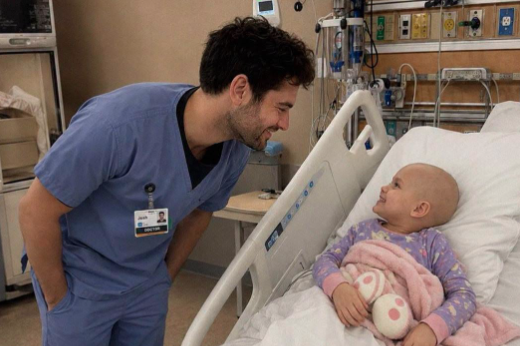
I used to think hospitals were places people visited for a few hours before going home with a prescription, a list of instructions and a promise to rest.
I never imagined one would become my daughter’s second home.
I never imagined I would learn every squeak in its floors, recognize every nurse by the sound of their footsteps, or know the difference between the machines’ warning tones without even looking up.
And I certainly never imagined that one of the most emotional moments of my daughter’s battle with cancer would begin with a secret.
My four-year-old daughter, Adeline, had been admitted to the pediatric oncology ward, and our lives had been reduced to silver heart monitors, harsh white lights and endless nights that never seemed long enough.
Being a single mother throughout her illness had been the hardest experience of my life.
Before cancer entered our world, Adeline’s biggest concerns were choosing which stuffed animal would sleep beside her and deciding whether I had cut the crusts off her sandwiches evenly.
She loved butterflies, glitter crayons and fairy tales where every story ended happily.
Those memories sometimes felt like they belonged to another family.
Now the hospital was our routine.
I slept on the narrow couch beside her bed more often than I slept in my own apartment.
My clothes permanently smelled like hand sanitizer and vending-machine coffee.
Every morning began with blood draws, medications and careful conversations filled with words like “progress,” “response” and “treatment.”
There was no second parent waiting at home to relieve me.
No one else to take the night shift.
Every decision rested on my shoulders.
And every smile I forced onto my face was for Adeline.
She deserved to believe everything would be all right, even on the days when I wasn’t sure I believed it myself.
The pediatric oncology floor was heartbreaking and hopeful at the same time.
Children decorated their IV poles with stickers.
Parents celebrated better blood counts with cupcakes from the hospital cafeteria.
Nurses remembered birthdays, favorite cartoons and which juice each child preferred.
Among those nurses was Josh.
He couldn’t have been much older than 30.
He spoke softly.
He moved patiently.
And somehow, he remembered something about every child.
The first time he cared for Adeline, she refused to let anyone touch her IV.
“I don’t like needles,” she whispered, hugging her stuffed rabbit tightly.
“I don’t either,” Josh replied with a sympathetic grin.
Her tiny eyebrows rose.
“You don’t?”
“Nope.”
“But you’re a nurse.”
“I know. Isn’t that ironic?”
She giggled.
It was the first genuine laugh I’d heard from her in days.
From that moment on, something changed.
Whenever Josh was working, Adeline seemed brighter.
She started tracking his shifts on a paper calendar we had taped beside her bed.
Every evening, she asked me to draw smiley faces on the dates he would be there.
“Tomorrow’s a Josh day!” she would announce.
If his shift changed unexpectedly, she would pout for an hour before deciding she could survive one more day without him.
I appreciated him more than I could put into words.
He never acted rushed.
He crouched down to Adeline’s eye level before explaining anything.
He asked permission before touching her arm.
And he celebrated every little victory.
If she finished a meal, he celebrated.
If she made it through another chemotherapy session without crying, he celebrated.
Watching him comfort frightened children made me believe that people really did choose nursing because they cared.
One afternoon, while I helped Adeline color princesses in a book, Josh stopped by to check her vital signs.
“What are we making today?” he asked.
“A castle,” Adeline announced proudly.
“It needs more sparkles.”
Josh nodded with exaggerated seriousness.
“I think every castle deserves sparkles.”
She laughed.
“You get it.”
He glanced at me with an amused smile.
“I’ve learned not to argue with royalty.”
As he wrapped the blood pressure cuff around her small arm, Adeline studied him carefully.
“You’re nice.”
“Thank you.”
“And handsome.”
I nearly dropped my blue crayon.
“Adeline.”
“What?”
“You don’t have to embarrass people.”
“I’m not embarrassed,” Josh said, laughing.
“I am,” I muttered.
He smiled and finished entering her numbers into the chart.
At the time, it seemed like nothing more than an innocent conversation between a four-year-old girl and the nurse she adored.
I had no idea those little moments would soon become part of a memory I would carry for the rest of my life.
