My sister-in-law held her wedding at the lake house my late grandmother left me. I opened the doors to the place I had spent years protecting because her original venue had suddenly become unavailable.
I thought I was doing my family a favor.
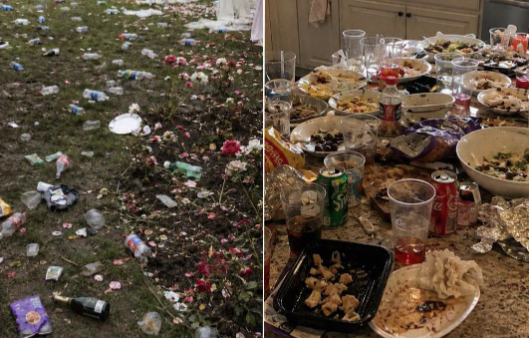
Instead, she tore apart Grandma’s garden, dragged heavy furniture across the lawn, left garbage scattered throughout the property, and treated years of memories as though they were nothing more than decorations that could be replaced.
And when I confronted her, she laughed.
She told me it was just dirt and flowers.
She told me to clean it myself.
What Kelsey didn’t know was that my grandmother had left behind something else with the house: a detailed map documenting every flower, every planting, and the memory attached to it.
So when Kelsey said those flowers would simply grow back, I decided to give her a wedding gift she would never forget.
It contained 286 reasons why she had been wrong.
My grandmother, Penny, believed flowers remembered things.
When I was eight years old, she handed me a green watering can and led me through the garden behind her lake house. She stopped beside a row of pink peonies, their blossoms moving gently in the summer breeze.
“These bloomed the year you were born, sweetheart,” she told me.
Then she smiled and added, “Plants have families too.”
At the time, I didn’t completely understand what she meant.
I only knew that Grandma seemed to know every flower in that garden as if each one were an old friend.
A few steps farther down the stone path, she reached toward the lavender.
“I planted this after my surgery,” she said. “Because hospitals smell terrible. I wanted the house to smell hopeful when I came back.”
The roses beside the porch marked her wedding anniversary.
The white daisies had appeared after my first school recital.
And in one empty corner of the garden, bee balm had taken root after a particularly difficult summer.
Grandma always described that planting the same way.
“This family needed something cheerful that refused to behave.”
I once asked her how she could possibly remember the story behind every single plant.
She knelt beside me and brushed a little soil from her gardening gloves.
“Flowers are better than photographs, Nadia,” she said. “They don’t only show you what happened. They prove somebody kept caring afterward.”
I didn’t fully understand that either.
Not then.
I understood it after she died.
Grandma left me the lake house.
It wasn’t a modern property. It didn’t have the newest appliances or the most fashionable furniture. But it was Grandma’s, and that made every imperfect detail matter.
Along with the keys, she left me a handwritten note.
It contained only three words:
Keep it lived in.
I took those words seriously.
I repaired what needed repairing, but I never modernized the house into something Grandma wouldn’t have recognized. The yellow cabinets remained. Her hand-sewn cushions stayed on the furniture. Even her old pancake griddle remained exactly where she had always kept it.
And every Saturday, I tended the garden.
My husband, Zac, understood what the property meant to me.
His sister, Kelsey, did not.
Kelsey approached life with the confidence of someone who had rarely heard the word “no” without immediately treating it as the beginning of a negotiation.
Two days before her wedding, she arrived at our house without calling.
She walked into the kitchen carrying a binder and three fabric samples.
“Nadia… Zac… the restaurant flooded.”
I put my coffee down.
“What?”
“A pipe burst overnight,” she explained. “The dining room is ruined.”
I immediately felt sorry for her.
Despite our complicated relationship, I couldn’t imagine how devastating that must have been with her wedding only two days away.
“Kelsey, I’m sorry.”
“I’ve already called every hotel and restaurant within sixty miles,” she said, frustration creeping into her voice. “They’re booked.”
Then she placed the binder on my kitchen counter and opened it.
Inside was a photograph of my lake house.
“So we’ll have it there.”
I stared at the picture.
“At Grandma’s house?”
“Your lake house, yes.”
“You can’t host a wedding there with two days’ notice, Kelsey.”
She looked at me as if I had missed something obvious.
“It’s a house beside a lake, Nadia. People pay thousands for that look.”
“It’s also not a wedding venue.”
She waved away my objection.
“We won’t need much. Chairs, tables, a dance floor, and some flowers.”
That last word immediately caught my attention.
“The garden is off-limits.”
Kelsey sighed.
“Nobody said anything about your garden.”
“You just said flowers.”
“I meant arrangements.”
“The answer is no.”
Her mouth fell open.
“You would let my wedding be ruined when you have a perfectly good property sitting empty?”
“It isn’t sitting empty. I use it.”
That was when Zac walked into the kitchen.
Kelsey began crying almost immediately.
She was remarkably good at crying without disturbing her mascara.
“My wedding is in two days,” she told him. “Nadia would rather protect a bunch of plants than help your sister.”
