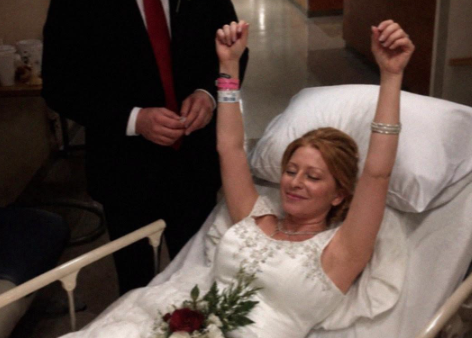
I knew Margaret was sick when we met.
I knew she had a rare autoimmune disease.
I knew there were hospital visits, treatments, medications and days when she could barely get out of bed.
What I didn’t understand was how bad it really was.
We were 27 when we met.
It was summer, and at that age, I honestly believed people like us didn’t die.
Not yet.
Not people who still had plans.
Not people who laughed too loudly, made stupid jokes and argued over what to order for dinner.
At least, not in my world.
Margaret had a way of making me believe that too.
She joked about hospital gowns.
She named her IV pole Stanley.
Whenever nurses asked her to rate her pain from one to ten, she’d look them straight in the eye and ask, “Emotionally or physically?”
And three weeks into dating, I accidentally typed “Margarine” instead of “Margaret” in a text message.
She never let me forget it.
“You realize margarine isn’t even real butter?” she complained.
“Neither is your attitude.”
“I’m seriously reconsidering this relationship.”
“You’d miss me.”
“Unfortunately.”
I loved her before I fully understood how frightened I was of losing her.
As the months passed, Margaret’s condition gradually became worse.
And I stayed.
I drove her to treatments.
I sat beside her during appointments.
I held her hand when she was scared.
Eventually, hospital cafeterias became more familiar to me than actual restaurants.
I knew which parking-garage elevator was always broken.
I learned how to sleep sitting upright in uncomfortable chairs.
I learned that when Margaret was nauseated, she wanted silence.
But when she was in pain, she wanted conversation.
So I learned how to talk about absolutely nothing.
Movies.
Food.
People we’d seen in the hallway.
The weather.
Anything that could make the minutes move a little faster.
Eighteen months after we met, I proposed.
It wasn’t elaborate.
There was no fancy restaurant.
No carefully planned surprise.
We were sitting on the floor of my apartment eating Chinese takeout because Margaret had been discharged from the hospital that afternoon and didn’t have enough energy to sit at the table.
I pulled out a ring.
She stared at it.
Then she looked at me.
Then she started crying.
I thought that meant yes.
It didn’t.
“No,” she said.
I actually laughed.
“No?”
“I can’t marry you,” she cried.
“You can,” I told her. “I checked. It’s legal.”
“Daniel.”
“What?”
She pushed the ring back toward me.
“I love you too much.”
I stared at her.
“That is an extremely confusing reason to reject someone.”
But she explained.
She didn’t want to make me a widower.
More than that, she was terrified that marrying her would leave me buried under medical bills and debt after she was gone.
I told her we’d talk to lawyers.
She refused.
Six months later, I proposed again.
“No.”
I asked again on our third anniversary.
“No.”
Once, I even proposed jokingly in the frozen-food aisle of a grocery store.
She threw a bag of peas at me.
Eventually, I stopped asking.
Not because I stopped wanting Margaret to be my wife.
I stopped because I understood something important.
Loving Margaret meant learning that sometimes pushing wasn’t devotion.
Sometimes it was just pushing.
By the time I was 31, our entire life revolved around her illness.
There were good months.
Bad months.
And eventually, there were months I stopped trying to describe.
I reduced my hours at work.
We canceled trips.
I drained most of my savings without telling Margaret.
Not because she asked me to.
Because there was always something.
A medication insurance wouldn’t fully cover.
A hotel near a specialist.
Transportation.
Food.
Lost work.
Unexpected bills.
I had once planned to use that money as a down payment on a house.
Margaret knew that.
She hated knowing it.
“You’re spending your future on me,” she told me once.
“You’re in my future.”
“You know what I mean.”
I did.
I just didn’t want to.
Then, four years after we met, doctors recommended surgery.
It was complicated.
“Experimental” wasn’t quite the right word.
But “reassuring” definitely wasn’t either.
There was a chance the procedure could dramatically improve Margaret’s condition.
There was also a chance her body wouldn’t tolerate it.
The week before the operation, I noticed something different about her.
She was unusually quiet.
I was sitting beside her hospital bed, absentmindedly peeling the label from a water bottle, when she reached for my hand.
“Daniel.”
“Hmm?”
“Marry me.”
I looked up.
She was completely serious.
I blinked.
“Yes, I got proposed to by a woman.”
She rolled her eyes.
“That’s your response?”
“I’m processing.”
“Process faster.”
I leaned closer.
“Margarine, I’ve asked you approximately 400 times.”
“Five.”
“You counted?”
“Obviously.”
“What changed?”
She looked down at our hands.
“Look,” she said, holding my hand. “I might not make it out of this surgery.”
My heart dropped.
“And if I don’t, I want to die as your wife.”
She looked at me.
“Not your girlfriend.”
Something inside me broke.
“Don’t say that.”
“Daniel, I—”
“You’re coming out of surgery.”
“Probably.”
“You are.”
“But if I don’t—”
“You will.”
She squeezed my hand.
“And if I do, we’ll have gotten married anyway. Seems efficient.”
I laughed.
Then I cried.
So did she.
“Is that a yes?” she asked.
“You’ve made me wait four years. I need time.”
She stared at me.
I lasted three seconds.
“Yes,” I said.
And that was how we got married.
We threw the lamest, most beautiful hospital wedding imaginable.
Our parents came.
A few close friends came.
Even a couple of doctors and nurses we’d grown close to over the years stood there with us.
There were no expensive flowers.
No ballroom.
No elaborate decorations.
No first dance.
One nurse found a white ribbon in the gift shop and tied it around Margaret’s bed rail.
My mother brought a grocery-store cake.
Across the top, in bright blue icing, were the words:
