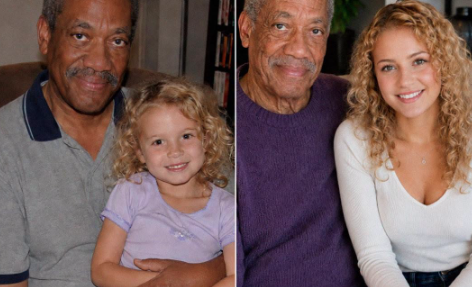
They say time heals.
I’m not sure that’s true.
Sometimes, time doesn’t heal anything. Sometimes, it simply teaches you how to carry the pain without talking about it.
I’m 70 years old.
I’ve buried two wives and outlived nearly everyone I once called a friend. Over the years, I’ve learned how to accept loss, how to wake up the morning after a funeral, how to put one foot in front of the other when a part of your life has disappeared forever.
You’d think that by now, nothing could shock me.
But grief has a strange way of surviving.
It changes shape.
It becomes quieter.
It settles into old memories and waits.
For twenty years, I believed I had learned how to live with what happened to my family.
It turns out I wasn’t living with the truth.
I was simply waiting for the truth to find me.
And it finally did.
It started on a night when the snow came down as if it had a grudge.
It was a few days before Christmas, twenty years ago.
My son Michael, his wife Rachel, and their two children had come over to my house for an early holiday dinner.
I lived in a small town where everyone waved at everyone else, whether they genuinely liked each other or not. Snowstorms weren’t unusual there. They were part of winter, as ordinary as morning coffee or scraping ice from your windshield.
That evening, however, the weather forecast didn’t sound particularly concerning.
The weatherman predicted light flurries.
Maybe an inch or two.
He was dead wrong.
The snow became heavier as the evening went on.
Wind began pushing against the windows.
By around seven, Michael decided it was time to get the children home.
I remember the exact moment they left.
Michael stood in the doorway holding his youngest daughter, Emily, who was five years old at the time.
She was half-asleep in her little puffy jacket.
Michael smiled at me with the calm confidence sons sometimes have when they believe they’ve got everything under control.
“We’ll be fine, Dad,” he said. “I want to get the kids home before it gets too late.”
I nodded.
“Call me when you get there.”
He smiled.
“We will.”
Then they walked into the snow.
I closed the door behind them.
The wind howled outside.
And something inside me twisted.
I can’t explain it.
There was no logical reason for it.
But I remember standing there with my hand still on the doorknob, feeling as though some alarm had gone off deep inside my body.
An alarm that came too late.
Three hours later, someone knocked on my door.
It was the kind of knock you never forget.
Sharp.
Urgent.
Heavy with something no one wants to hear.
When I opened the door, Officer Reynolds was standing there.
Snow was melting from his jacket.
But what I remember most was his face.
Sorrow was already written across it, as if he had practiced delivering the news before he ever reached my house.
There had been an accident.
The rural road Michael had been driving on had iced over.
Their car had gone off the shoulder and crashed into the trees.
My son was gone.
Rachel was gone.
My oldest grandson, Sam, only eight years old, was gone too.
Only Emily survived.
She was five.
I remember sitting in the emergency room hallway afterward.
Emily had suffered a concussion, broken ribs and severe bruising from the seatbelt. Under the fluorescent hospital lights, some of the bruises looked almost black.
She barely spoke.
The doctors told me the trauma had affected her memory.
They called it confusion.
Fragments.
They said it was best not to force her to remember anything.
Let the memories return naturally, they said.
Or perhaps they wouldn’t return at all.
So I didn’t push.
I became her guardian almost overnight.
One day I was a grieving father.
The next, I was a full-time parent to a five-year-old girl.
I was 50 years old.
I had no warning.
No preparation.
No idea how I was supposed to raise a child who had just lost almost her entire immediate family.
The doctors called Emily’s survival a miracle.
The police called it a miracle.
The pastor said the same thing at the funeral as he stood in front of three closed caskets.
But miracles don’t erase grief.
They don’t make a five-year-old understand why her mother and father aren’t coming home.
They don’t make a grandfather understand how to become a parent again overnight.
So I simply did what needed to be done.
I learned how to cook meals I hadn’t prepared in twenty years.
I learned how to comb a little girl’s hair without making her cry.
I learned how to sit in a school gym and hold back tears while watching her perform as Snowflake Number 3.
Emily didn’t ask for much.
She never threw tantrums.
She rarely complained.
She never demanded attention.
Sometimes, she would simply look at me.
And there was something about that look I could never explain.
It was almost as if she were waiting for someone else to walk through the door.
Someone who wasn’t coming.
We never really talked about the crash.
Not in any meaningful way.
She asked where her parents were.
She asked why they weren’t coming back.
And I gave her the answer I’d repeated to myself a hundred times.
“It was an accident, sweetheart. A bad storm. Nobody’s fault.”
She would nod.
Then she would stop asking.
Years passed.
Emily grew into a quiet, observant and incredibly intelligent young woman.
She did well in school.
She loved puzzles.
She liked mystery books.
She never caused trouble.
She never broke curfew.
She was serious in ways that sometimes made her seem much older than she actually was.
It was as though she carried something heavy inside herself.
Something she couldn’t name.
When she left for college, I cried more than I had at her parents’ funeral.
That’s not an exaggeration.
You don’t realize how much life another person brings into a house until that person leaves.
The rooms become quieter.
Dinner becomes smaller.
There are fewer footsteps.
Fewer voices.
Four years after graduation, Emily came back home.
She said she wanted to save money before getting a place of her own.
She found a job as a paralegal for a small local legal research firm downtown.
She was already talking about clerking someday.
At 25, my girl was brilliant and independent.
But somehow, whenever I looked at her, I could still see the five-year-old who used to fall asleep on my shoulder whenever snow came down outside.
Eventually, we found our rhythm again.
She would come home around six.
We’d eat dinner together.
She would tell me about strange cases, legal trivia and things she had learned at work.
I loved every minute of it.
For a while, life felt almost normal.
Then, a few weeks ago, just before the anniversary of her parents’ and brother’s deaths, something changed.
Emily became quieter.
But it wasn’t the kind of quietness that comes from being tired or moody.