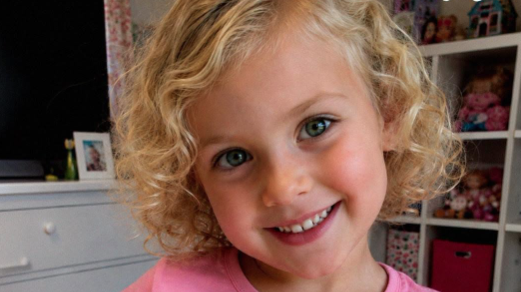
My daughter Grace was five years old when she died.
For a long time, I believed the worst moment of my life was the moment the doctor walked into the hospital hallway, looked at me with a face that told me everything before he even spoke, and said the words no mother should ever have to hear.
“I’m sorry. She didn’t make it.”
I thought nothing could ever hurt more than that.
I was wrong.
The worst moment came a week after Grace’s funeral.
I was sitting alone in her bedroom, surrounded by the little things she had left behind, when I found a crumpled note hidden inside the sleeve of her pink sweater.
The note contained only one message:
“Your husband is lying to you. Watch the video. Alone.”
There was a black flash drive taped to the bottom of the bag.
And when I watched what was on it, I learned that Grace hadn’t died from the mysterious illness we had been told about.
Someone had ignored a warning.
Someone had tried to stop it.
And someone else had helped make sure I never learned the truth.
Grace had seemed perfectly fine at first.
Then, on a Tuesday, she woke up with a fever.
By Thursday night, she was lying in a hospital bed with wires attached to her chest and a red allergy band wrapped around her wrist.
I had repeated the same warning over and over because I was terrified someone would miss it.
“Penicillin,” I kept saying.
“Severe allergy. Please write it down.”
Every time I said it, the medical staff nodded.
I watched them write things down.
I watched them check her chart.
I trusted them.
By Friday afternoon, Grace had been moved to the ICU.
Daniel stood at the foot of her bed with his hands in his pockets.
He wore that tight, polite expression he always used when speaking to strangers, as though he was trying to remain calm and composed even when everything around him was falling apart.
He leaned over and kissed Grace’s forehead.
“You’re brave,” he whispered.
Then his phone buzzed.
He looked at the screen and immediately stepped into the hallway.
When I asked who it was, he barely looked at me.
“Work,” he said.
Then he added:
“It’s nothing.”
I remember feeling irritated by the answer.
Our daughter was in intensive care, and somehow work still seemed important enough to interrupt the moment.
But I didn’t push him.
At that point, I was focused entirely on Grace.
On Saturday morning, the alarms started.
Everything happened at once.
The sounds of machines filled the hallway.
People moved quickly.
A nurse named Hannah appeared beside Grace’s bed. She had tired eyes and quick hands, the kind of person who looked as though she had been working for hours but still hadn’t stopped moving.
She checked Grace’s chart.
Then she circled the allergy information in thick ink.
“You did the right thing bringing her in,” Hannah told me.
I nodded, barely able to speak.
Then the situation escalated.
Another nurse, Kara, blocked the ICU door with her arm.
“Ma’am, you have to stay out here.”
“My daughter is in there,” I said.
My voice broke.
“She’s five.”
“I know,” Kara said gently.
“We need space.”
I watched strangers rush past me.
I watched the ICU doors swing inward and then close again.
I stood there helplessly, knowing my little girl was on the other side.
A few minutes later, a doctor stepped into the hallway.
His name was Dr. Patel.
His voice was calm.
His jaw was clenched.
“I’m so sorry,” he said.
“We did everything we could.”
Daniel’s hand landed on my shoulder.
It was steady.
Mine wasn’t.
After that, everything became a blur.
The funeral happened because Daniel took charge of it.
I couldn’t.
I could barely get through the day without feeling as though I was drowning.
My sister Mia answered the door when people came to the house. She stacked casseroles on the counter. She reminded me to eat. She kept telling me the same thing.
