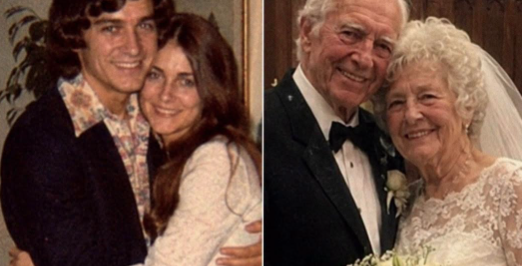
My children were convinced I was being manipulated when I agreed to marry the man who had abandoned me more than five decades earlier. His family believed I was after his money. Even I questioned whether I was making the right decision.
But there was a truth Thomas had carried with him for 55 years.
I would not discover it until after we buried him, when his attorney placed a small brass key in my hand.
It was the key to a safe-deposit box.
Inside were letters, photographs, old documents, and the answer to the question that had haunted me for most of my adult life:
Why had Thomas walked away from me one month before our wedding?
When Thomas called me after 55 years, I was so shocked that I could barely speak.
He was the last person in the world I expected to hear from.
There was a pause after I answered. I could hear someone breathing softly on the other end of the line.
Then he said my name.
“Eleanor.”
I recognized that voice immediately.
Decades had passed since I had last heard it, yet something inside me knew it before my mind could catch up.
I sat down at my kitchen table so quickly that tea spilled across the saucer.
“Thomas?”
His laugh was weak and brief.
“So you remember me.”
I looked toward the framed photograph of my late husband, George, sitting on the shelf.
George had been gone for four years by then.
We had shared 46 good years together. We had raised three children, welcomed five grandchildren, argued about money, taken vacations that sometimes went terribly wrong, endured illnesses, celebrated birthdays, and built the kind of ordinary life that becomes precious only when you look back on it.
I would never call my marriage to George second best.
It wasn’t.
He had been my husband, my companion, and the man who stood beside me through nearly half a century of life.
But before George, there had been Thomas.
And at 18, I had believed Thomas and I were going to grow old together.
We had already chosen names for children we didn’t have.
We walked past houses and imagined which one we would buy someday.
We talked about the future as if it were already waiting for us.
Then, beneath an oak tree behind my parents’ church, Thomas gave me a thin gold ring and asked me to marry him.
I said yes.
I never imagined that the same man would become the greatest unanswered question of my life.
One month before our wedding, a letter arrived.
It contained only a few sentences.
“Eleanor,
I have made my choice. I cannot marry you. Do not wait for me, and do not try to contact me.
Thomas.”
That was all.
There was no explanation.
No goodbye.
No opportunity for one final conversation.
Within weeks, Thomas had moved away.
For years, I wondered what I had missed.
I replayed every conversation in my head. Every kiss. Every promise. Every moment when he looked at me as though I were the only woman in the world.
Had there been another woman?
Had he fallen out of love?
Had he suddenly realized that I wasn’t enough?
The uncertainty was sometimes more painful than the rejection itself.
Eventually, I stopped asking questions I knew I could never answer.
I married George.
I raised our family.
I became a teacher, then a grandmother, and eventually a widow.
Thomas became a sealed room in my memory.
A room I had locked long ago and convinced myself I would never enter again.
Until that phone call.
“What do you want?” I finally asked.
There was a long pause.
Then he said:
“I am dying.”
I closed my eyes.
“I’m sorry.”
“Pancreatic cancer,” he said. “The doctors say I have weeks, not months.”
I held the phone tighter.
“Why are you calling me?”
“Because I need to ask you for one last favor.”
He asked me to see him the following afternoon.
When I told my daughter Rachel, she thought I had lost my mind.
“He abandoned you,” she said. “Now he calls because he’s dying and expects you to come running?”
“He isn’t asking me to run.”
“You don’t even know what he’s asking.”
She was right.
Neither did I.
Thomas lived two hours away in a private care residence.
The following afternoon, I drove there.
When I entered his room, I found an old man sitting beside the window.
For one second, I saw no trace of the young man I had loved.
Then he looked up.
His eyes were the same.
“Eleanor.”
I remained near the door.
“You look well,” he said.
I looked at him.
“You look terrible.”
He laughed softly.
“Still honest.”
He was thin, his skin gray, his hands trembling. An oxygen tube ran beneath his nose.
Then I noticed something on the table beside him.
A photograph.
It was a photograph of me at 18.
I stared at it.
“Why do you have that?”
“I kept more than I should have.”
He gestured toward a chair.
I sat down, but I kept my coat on.
I had no intention of staying longer than necessary.
“What is the favor?”
Thomas looked toward the window.
“Marry me.”
For a moment, I thought I had misunderstood him.
“What?”
“I am asking you to become my wife.”
I stared at him.
“You’re dying.”
“I know.”
“We haven’t spoken in 55 years.”
“I know that too.”
I stood.
“This is cruel.”
“No.”
“You break my heart, disappear for more than half a century, and then call me at the end of your life because you’re lonely?”
“It isn’t loneliness.”
“Then what is it?”
His eyes filled with tears.
“I cannot explain everything yet.”
I gave a bitter laugh.
“Of course you can’t.”
“I need you to trust me once more.”
“You are asking the one person who has every reason not to.”
He lowered his head.
“I know.”
I left without saying goodbye.
That night, I told my children what had happened.
Rachel was furious.
My son, Andrew, immediately asked whether Thomas wanted to leave me money.
“I don’t know.”
“Then maybe this is about inheritance.”
“I don’t want anything from him.”
My youngest daughter, Claire, was quiet for a long time.
Then she asked the question none of us had wanted to say aloud.
