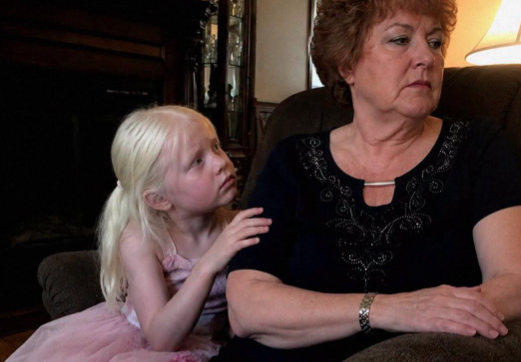
For six years, I watched someone I once trusted treat my little girl as if she were almost invisible.
I couldn’t understand it.
I tried to explain it away. I told myself that maybe my mother-in-law simply needed time. Maybe she was uncomfortable. Maybe she didn’t know how to handle something she wasn’t familiar with.
But as the months turned into years, her behavior became harder and harder to excuse.
Then, one ordinary afternoon, I saw a message on her phone.
What I read didn’t just explain why she had kept her distance from my daughter.
It completely changed the story I thought I knew.
When my husband, Joey, and I discovered that I was pregnant, one of the first people I wanted to tell was my mother-in-law, Diane.
At the time, Diane and I were actually quite close.
She could be dramatic. She could be opinionated. Sometimes she had a way of turning small situations into much bigger ones.
But I genuinely believed she would be an incredible grandmother.
I imagined her spoiling our baby, filling the house with gifts, taking endless photographs, and telling everyone who would listen about her first grandchild.
So when I showed her the pregnancy test with two pink lines, I expected her to be excited.
I didn’t expect her reaction to be quite that dramatic.
She stared at the test for about three seconds.
Then she suddenly jumped out of her chair.
“YOU’RE PREGNANT?!”
Before I could even answer, she wrapped her arms around me so tightly that I could barely breathe.
When she finally pulled away, her eyes were filled with tears.
“I’m going to be a grandmother,” she kept repeating, pressing both hands against her cheeks. “Oh, my goodness. I’m going to be a grandmother!”
Within minutes, Diane was already planning our baby’s future.
She talked about cribs, tiny clothes, birthdays, Christmas mornings, family vacations, and all the things she wanted to do with her first grandchild.
“We don’t even know if it’s a girl yet,” Joey reminded her, laughing.
“I know,” Diane replied. “But I have a feeling.”
She was right.
When we found out we were having a girl, Diane nearly lost her mind with excitement.
She bought tiny dresses, stuffed animals, blankets, and so many pink socks that it looked like she was preparing to outfit an entire daycare.
Back then, everything seemed perfect.
Nine months later, our daughter, Lily, was born.
The moment the nurses placed her in my arms, I knew she looked different from what we had expected.
Her skin was incredibly pale.
Her eyelashes and eyebrows were almost completely white.
Her hair was the softest shade of white-blond I had ever seen.
The doctors performed several examinations and eventually explained that Lily had albinism.
I’ll admit that I was scared at first.
Not because there was anything wrong with my daughter—there wasn’t—but because we suddenly had challenges we hadn’t prepared ourselves for.
Her eyesight would need to be monitored.
Her skin would be extremely sensitive to sunlight.
There were medical appointments and precautions we would have to learn about.
My husband and I had a lot to understand.
But none of that mattered when I looked down at her tiny face.
She was my daughter.
She was healthy in the ways that mattered most.
And she was beautiful.
Then Diane walked into the hospital room.
I’ll never forget what happened next.
She entered with a huge smile, carrying a pink gift bag and a ridiculous number of balloons.
She practically rushed toward my bed.
Then she saw Lily.
Her smile vanished.
She stopped in the middle of the room.
The gift bag slipped slightly in her hand, and all the color seemed to disappear from her face.
Joey gave a nervous laugh.
“Mom, come meet your granddaughter.”
Diane didn’t move.
She simply stared at Lily.
Then she whispered one word.
“No.”
I frowned.
“Diane?”
She turned around and walked straight back out of my hospital room.
She didn’t kiss me goodbye.
She didn’t congratulate her son.
She didn’t touch her granddaughter.
She didn’t even say another word.
At first, I was too stunned to understand what had happened.
I looked at Joey.
“What was that?”
He stared toward the doorway.
“I don’t know.”
I desperately wanted to believe there was some innocent explanation.
I wanted to believe Diane would come back later that day and tell us what was wrong.
She never did.
And for the next six years, she behaved as though Lily barely existed.
Diane posted constantly on Facebook.
She shared pictures from birthday dinners, photographs of a neighbor’s dog, casseroles she had made, flowers blooming in her backyard, and countless other ordinary moments from her life.
But there were no pictures of Lily.
Not one.
Whenever someone asked Diane about her grandchildren, she would quickly change the subject.
And whenever Lily and Diane happened to be in the same room, Diane would barely look at her.
At first, I told myself she needed time.
Then months became years.
Eventually, I stopped making excuses for her.
Joey and I argued about it constantly.
“Mom’s just uncomfortable,” he would tell me. “Give her time.”
“She’s had four years,” I’d answer.
Then five.
Then six.
What made it even harder was that Diane was never openly cruel.
She didn’t insult Lily.
She didn’t yell at her.
She didn’t say anything obviously hateful.
Instead, she simply withdrew.
And sometimes that was even more painful.
Once, we were walking through a parking lot when Lily reached for Diane’s hand.
Diane pulled away so quickly that Lily froze.
I saw it.
Joey saw it too.
That night, I confronted him.
“Did you see what your mother did?”
He sighed.
“Judy.”
“No. She pulled her hand away from our daughter like Lily burned her.”
“I’ll talk to her.”
“You always say that.”
He went silent.
That silence became part of the problem.
Diane wouldn’t explain herself to me.
She wouldn’t explain herself to Joey either.
By the time Lily was six, she had started noticing.
One night, I was tucking her into bed when she looked up at me and asked the question I’d been dreading.
“Mommy, why doesn’t Grandma like me?”
My heart broke.
I brushed her white hair away from her forehead.
“Oh, honey. Grandma is a difficult person sometimes. But deep down, she loves you very, very much.”
Lily stared at me for several seconds.
Then she quietly said:
“I don’t think so.”
She rolled over and went to sleep.
I walked into the bathroom afterward and cried.
That was the moment something changed inside me.
For six years, I had tried to keep the peace.
I had tried to protect the family relationship.
I had made excuses.
But Lily was old enough to understand rejection now.
And I wasn’t going to let my daughter grow up believing she had to beg someone to love her.
After that, I stopped bringing Lily around Diane unless it was absolutely necessary.
Joey wasn’t happy about it.
But eventually, he understood why I was doing it.
I thought I had accepted that this was simply our reality.
Then one afternoon, everything changed.
We were at Diane’s house.
Joey was in the garage helping his father with something, while Diane had gone outside to work in her garden.
Lily had stayed home with my sister, so I was alone in the kitchen.
I was pouring myself a glass of water when Diane’s phone buzzed on the counter.
A message appeared on the screen.
It was from her sister, Claire.
Normally, I wouldn’t have looked.
I had no reason to.
But the message preview caught my attention.
“My condolences. I hope you’re okay today. I miss her too.”
There was a photograph underneath it.
I could only see a small portion of the image from the notification preview.
But the second I saw it, my stomach dropped.
It was a little girl.
She couldn’t have been older than six or seven.
She had incredibly pale skin.
Nearly white eyebrows.
Long, white-blond hair.
For one terrifying second, I thought I was looking at Lily.
Then I realized the photograph was old.
The clothes were different.
The image itself had the faded look of an older photograph.
Underneath it, partially visible in Claire’s message, were five words that made my hands start shaking.
“She looks so much like…”
I heard the back door open behind me.
I turned around.
Diane stood in the doorway wearing her gardening gloves.
Her eyes moved from my face to the phone on the counter.
Then she saw the message glowing on the screen.
Her gloves slipped from her hands and fell to the floor.
“Judy,” she whispered.
For the first time in six years, I saw something different on Diane’s face.
It wasn’t disgust.
It wasn’t discomfort.
It wasn’t indifference.
It was fear.
And suddenly, I wondered whether I had been wrong about her all along.
Neither of us moved.
Diane stared at the phone as if it were something dangerous.
I pointed toward the screen.
“Who is that little girl?”
Her face tightened.
“You shouldn’t be looking at my messages.”
“I didn’t pick up your phone. The message appeared on the screen.”
Diane quickly crossed the kitchen and grabbed the phone.
“Then forget what you saw.”