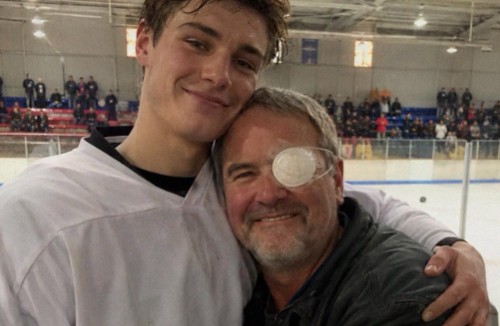
The last person I expected to see in the stands that night was a ghost from a painful part of our past.
I watched my son step onto the ice, surrounded by the roar of the crowd, and I couldn’t shake the feeling that the championship game was about to become something much bigger than hockey.
Fourteen years earlier, I had never imagined that a single phone call would completely change both our lives.
The phone rang at 2 a.m. on a Tuesday in November.
I still remember the cold kitchen tile beneath my bare feet when I picked up the receiver. I remember the silence on the other end for a second, and then the way Danny’s voice cracked before he could even finish his first sentence.
“Tom. She’s gone. Rachel’s gone.”
I gripped the phone so tightly that my knuckles turned white.
Rachel was my best friend’s wife. She was only 31 years old.
An aneurysm.
There had been no warning. No time to prepare. No goodbye.
Their four-year-old son, Marcus, was asleep in the next room, completely unaware that when he woke up, his mother would not be there to make breakfast.
“Tom. She’s gone.”
Danny repeated it again, as if saying the words out loud might somehow make them real.
Then his voice broke.
“I can’t do this, Tom. I can’t.”
“I’m so sorry, buddy,” I told him. “I’ll be there in the morning. Just hold on.”
But even as I said those words, I had no idea what I was walking into.
I was 28 years old, single, and working as a mechanic for $19 an hour.
I certainly wasn’t prepared to become a father.
But life doesn’t always ask whether you’re prepared.
Sometimes, it simply puts a child in front of you and asks what you’re going to do.
I drove to Danny and Rachel’s house the next morning. I got there at 7 a.m. with two cups of coffee and absolutely no real plan.
I knocked.
Nobody answered.
I tried the door handle.
It was unlocked.
Inside, the house was strangely quiet except for cartoons playing softly on the television.
Then I saw Marcus.
He was sitting on the living room rug in his pajamas, eating dry cereal from a plastic bowl.
He looked up at me with the innocent confusion of a four-year-old who had no idea why the adults around him were acting differently.
“Where’s Daddy?”
I looked around.
Danny was gone.
I found a note on the kitchen counter.
Four words.
“I’m not built for this.”
I stood there staring at that sentence for what felt like an eternity.
Then I looked back at Marcus.
He was still waiting for an answer.
“Where’s Daddy?”
I knew right then that something had changed.
I knew Danny wasn’t coming back.
And I knew I couldn’t leave that little boy alone to deal with the consequences of a decision he was far too young to understand.
Rachel and Danny had no other relatives who were willing to take Marcus.
The alternative was foster care.
I couldn’t imagine it.
So I made a decision that would change the rest of my life.
I decided I would become the best father I could possibly be.
The adoption process took 11 months.
Our lawyer, a kind woman named Patricia, charged me half her normal rate. She told me to pay her whenever I could.
I moved Marcus into my one-bedroom apartment.
And then, somehow, we became a family.
It wasn’t easy.
There were no instructions.
No manual.
No preparation course for suddenly becoming a single father at 28.
I learned how to cut Marcus’s hair before second-grade school picture day.
I packed peanut butter sandwiches for him every morning for nearly a decade.
I missed work shifts because he had fevers.
I missed work for field trips.
I missed work when he broke his arm at the skating rink.
My boss probably would have fired me twice if it weren’t for Eddie.
Eddie was my coworker, a wiry man in his 50s who chewed sunflower seeds and rarely said much.
But he always seemed to know when I needed help.
He’d cover my bays without even being asked.
“Go to the kid’s recital, Tommy,” he’d tell me. “I got this.”
“Eddie, I owe you.”
“You don’t owe me nothin’. Just go.”
So I went.
I showed up.
Every time.
Danny never called.
Not on birthdays.
Not on Christmas.
Not once.
Fourteen years passed that way.
Marcus grew up.
He became a tall kid with his mother’s eyes and a wicked hockey shot that made grown men whistle from the stands.
By his senior year, he was averaging 18 points a game.
The entire town seemed to know his name.
There were stickers for his team on pickup trucks all over town.
People stopped me at the grocery store to talk about his latest game.
And every time they did, I felt the same quiet pride.
The state championship was only a week away when I watched Marcus grab his hockey bag from the kitchen chair.
For a moment, I thought about Rachel.
I wondered what she would have thought if she could see him now.
I wondered how proud she would have been.
“You good, Dad?” Marcus asked.
I realized I had been staring.
“You’re staring.”
“Yeah,” I said. “Just thinking.”
He smiled.
But the smile didn’t quite reach his eyes.
Marcus had been different for the last few months.
Quieter.
More distracted.
Always on his phone.
Twice, I walked into the living room and caught him quickly turning his phone face down against his thigh.
I told myself it was nothing.
Maybe a girl.
Maybe senior-year drama.
Maybe something every teenager kept to himself.
But deep down, I knew there was something else.
Then, just after 11 a.m. one morning, there was a knock on my bedroom door.
By then, I had managed to move us into a two-bedroom apartment. Marcus was 13 when we’d done it, and now he was 18.
I already knew something was wrong.
“Dad, are you up?” he asked.
I sat up against the headboard and switched on the lamp.
“Yeah, buddy. Come in.”
Marcus walked into the room and sat at the foot of my bed.
He had done that countless times when he was younger.
At 11, he would sit there whenever a thunderstorm kept him awake.
Now he was six feet two, nearly a grown man, and still somehow the same kid to me.
“I’ve gotta tell you something,” he said. “And I need you to hear me out before you say anything.”
My stomach tightened.
“Okay.”
He looked down at the quilt.
“I invited Danny to the championship tomorrow.”
I didn’t speak.
I couldn’t.
That name hadn’t been spoken in our house in maybe a decade.
Hearing it come from Marcus’s mouth felt like somebody had flipped on a light in a room I’d kept dark for years.
“He found me on Instagram three months ago,” Marcus continued.
He was talking faster now.
“He kept messaging me. Stuff like, ‘I want to make it right, son.’ And, ‘Let me be there for the big moments.'”
I stared at him.
“He said he’s changed,” Marcus continued. “He’s married now. Her name is Cheryl. And he got rich in commercial real estate.”
“Three months?”
My voice came out sharper than I intended.
“You’ve been talking to him for three months and didn’t tell me?”
Marcus lowered his eyes.
“I kept trying to.”
He swallowed.
“But every time I opened my mouth at dinner, I chickened out. I figured if I waited any longer, you’d hear it from somebody else, and that’d be worse.”
“Scared of what, exactly?”
He finally looked at me.
“Scared you’d think I was choosing him.”
I rubbed my hand over my face.
“Marcus, do you know what time he called me the night your mom died?”
“Dad…”
“Two in the morning.”
I paused.
“And you were the only one there when I arrived.”
“I know the story.”
“Then you know what kind of man walks out on a child.”
Marcus’s eyes were wet now.
But his jaw was set.
He wasn’t backing down.
“Dad, please try to understand.”
His voice softened.
“I’m not asking you to like him. I’m asking you to trust me.”
I wanted to forbid it.
I wanted to tell him that Danny didn’t get to disappear for 14 years and then suddenly walk into the most important night of Marcus’s life pretending to be his father.