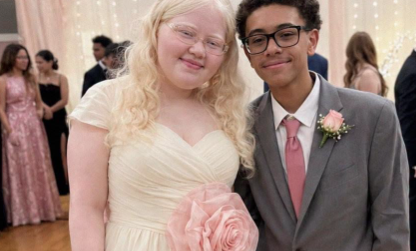
After a year of grief, one mother makes a fragile attempt to pull her teenage daughter back into the world. But a painful afternoon before prom reveals that the girl’s silence has been carrying far more than anyone realized.
The house had learned how to hold its breath after Mason died.
For an entire year, silence had settled into the walls. It lived in the unwashed coffee mugs on the kitchen counter, in the quiet hallways, and especially behind the closed bedroom door at the end of the hall.
That was where my daughter lived now, almost like a ghost in her own home.
Most mornings, I stood outside that door with my palm pressed against the wood, listening for the sound of her breathing.
Hazel was seventeen.
Before Mason died, she used to dance in the kitchen while I made pancakes. She would laugh too loudly, steal pieces of food from the counter and spin around the room without caring whether anyone was watching.
Her brother Mason used to call her “Hazelnut.”
He would steal the syrup from her plate and tease her until she threatened to throw something at him.
And he had once made her a promise.
If no boy was smart enough to ask her to prom, he would put on a tuxedo himself and take her.
Mason never got the chance.
A truck on Route 9. A wet road. A Tuesday.
That was all it took to turn our family upside down.
After the funeral, Hazel stopped eating.
Then she ate too much.
Then she stopped going outside.
The girl who once danced through the kitchen disappeared behind the bedroom door.
Eli was the only person she would still allow near her.
He was the quiet boy from two houses down, Hazel’s best friend since sixth grade. After school, he would walk over with her homework folded neatly under his arm.
He never knocked too loudly.
He never demanded answers.
He never asked her why she wasn’t eating or why she didn’t want to leave the house.
He simply sat beside her.
Some afternoons, I would find them on the porch without saying a word to each other. Hazel would have her head tipped sideways against the railing while Eli sketched something in a notebook.
One afternoon, he looked up at me.
“Mrs. Mave,” he said.
He had called me that since he was twelve. He had decided calling me only by my first name felt too casual, while anything more formal seemed too distant.
“She ate half a sandwich today.”
“Thank you, Eli.”
He shrugged.
“For what?”
“For sitting with her.”
He shrugged again, as though it was nothing.
To him, I think it was.
I found Hazel’s journals once.
They were the old ones from freshman year, tucked behind a row of paperbacks.
I shouldn’t have read them, but I did.
There were names of girls.
Names of boys.
Cruel little phrases written in Hazel’s round handwriting — the kind of things people write down because they are too painful to say out loud.
I put the journal back exactly where I had found it.
That spring, prom invitations began appearing in other girls’ mailboxes.
I saw the photographs their mothers posted online. Daughters in pastel dresses, smiling for cameras, holding bouquets and posing with their friends.
Eventually, I knocked on Hazel’s bedroom door.
“Sweetheart. Prom is in three weeks.”
“I’m not going, Mom.”
“Mason wanted you to go.”
Silence.
Then I heard the bed creak.
Footsteps approached the door.
It opened an inch.
“Mason wanted a lot of things.”
“He wanted you to wear a dress and dance and laugh,” I said. “He told me so.”
“Mom.”
I should have known better.
But I couldn’t stop trying.
“Just try one on,” I said. “One dress. If you hate it, we come home and never speak of it again. Deal?”
She looked at me through that narrow opening.
For the first time in months, something flickered behind her eyes.
It wasn’t hope.
Not exactly.
Maybe it was curiosity.
Maybe it was simply a small permission to try.
“One dress,” she finally said.
The following Saturday, I drove to the strip mall with both hands tight around the steering wheel.
There was something dangerous sitting in my chest.
Hope.
After a year of nothing, I was daring to feel hopeful again.
I should have known better.
By the fourth shop, I could see Hazel folding into herself.
The first three boutiques had used softer language.
“Limited inventory.”
“Sample sizes only.”
“We could special order, but not in time.”
They never said directly that they didn’t have dresses for her.
But Hazel understood.
So did I.
By the fourth shop, her shoulders had risen toward her ears in the same way they had during Mason’s funeral.
I tried to keep my voice bright.
“There’s one more place. The pretty one on Maple.”
“Mom.”
“Just one more, sweetheart.”
The boutique on Maple had a gown in the window that I had already pictured on her.
Ivory.
Soft.
Romantic.
Hazel stood in front of the glass for a long moment.
Then she surprised me.
“Could I try the one in the window?”
The saleswoman looked her up and down.
Her mouth tightened slightly at the corners.
“That’s not going to work for you, honey.”
She paused.
“You’re too big.”
That was it.
No apology.
No attempt to soften the words.
No concern for how they might land.
Hazel didn’t cry.
She didn’t argue.
She simply turned around, walked out of the boutique and climbed into the passenger seat of my car.
I followed her, my hands shaking as I reached for the keys.
She stared straight ahead.
“Hazel, I’m so sorry. I’m going to go back in there and—”
“Please drive.”
“Sweetheart—”
“Please. Just drive.”
The entire ride home, she stared through the windshield.
I kept glancing at her, waiting for something.
A breakdown.
Tears.
Anger.
Anything.
Nothing came.
That frightened me more than sobbing would have.
When we got home, Hazel walked inside, climbed the stairs and closed her bedroom door.
Then I heard the lock click.
I went upstairs.
I sat on the carpet outside her room with my back against the door.
“Hazel. Open the door. Please.”
“I’m not going to prom, Mom.”
“Honey, we can find something. We can sew something ourselves. We can—”
“Mom. Stop.”
Her voice was flat.
Exhausted.
“I’m not going. Please just stop trying.”
I pressed my forehead against the door and cried as quietly as I could.
I had buried one child.
Now I could feel the second one slipping away through the gap beneath that bedroom door.
And I had no idea how to hold on.
I don’t know how long I sat there.
Long enough for my legs to go numb.
Long enough for the light in the hallway to change.