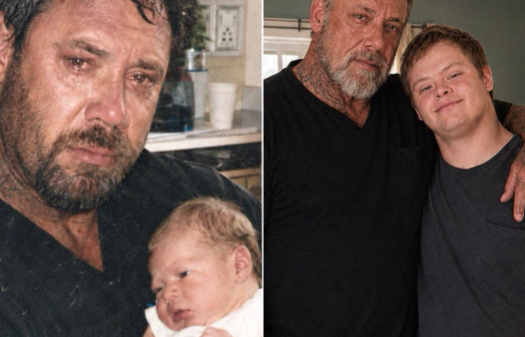
For 18 years, I called my wife a coward.
I told myself she had abandoned our newborn son because he had Down syndrome. I convinced myself that she had seen the diagnosis, decided motherhood was too difficult, and walked away from both of us.
For 18 years, I carried that anger.
Then, last night, I unfolded a letter she had written before she disappeared.
And suddenly, the story I had been telling myself for nearly two decades was only half the truth.
Eighteen years ago, everything changed in a hospital room.
A doctor sat beside my wife’s bed and quietly explained that our newborn son, Leo, had Down syndrome.
I remember looking at him for the first time.
He was tiny.
He had dark hair, a round little face, and fingers so small that his entire hand could wrap around the tip of mine.
To me, he was perfect.
There was nothing about him that needed to be fixed.
Then I looked at my wife, Goldi.
She barely looked at him.
She stared at the floor while the doctor explained what the diagnosis could mean for our son as he grew. Leo might need heart examinations. He would need hearing tests. He could benefit from early intervention and might require additional medical support.
The doctor spoke calmly, trying to prepare us for what could come.
When he finally left the room, Goldi whispered something that I thought was simply the voice of a terrified new mother.
“I can’t do this.”
I honestly believed she was in shock.
I pulled my chair closer to her bed.
“We don’t have to know how to do everything today,” I told her. “We’ll figure it out together. One day at a time.”
She shook her head.
“No, Arthur. I can’t.”
“You’re frightened. So am I.”
She turned toward the window.
“You’re not listening to me. I can’t do this.”
For the rest of that afternoon, she refused to hold Leo.
I fed him.
I changed him.
I held him against my chest.
Meanwhile, Goldi barely acknowledged either of us.
I told myself she was simply struggling to accept the diagnosis.
I was struggling too.
But she had just gone through labor and childbirth, and I knew I needed to step up.
I kept believing that, eventually, she would understand that we were in this together.
That we would learn.
That we would support each other.
That we would raise our son the way every new parent learns to raise a child: one day at a time.
That night, I woke in the chair beside her hospital bed.
The room was dark.
For a moment, I didn’t know where I was.
Then I saw Goldi standing beside Leo’s bassinet.
Her back was turned toward me.
One hand hovered above his blanket.
It looked as though she wanted to touch him but couldn’t make herself do it.
I closed my eyes before she realized I was awake.
The next morning, she was distant again.
Then she asked me a question that I didn’t understand.
“Could you raise him alone?”
I thought she was asking what would happen if something happened to one of us someday.
“I wouldn’t have to,” I said. “He has both of us.”
She began crying.
I reached for her, but she turned away.
Two days later, Goldi told me she wanted a divorce.
I laughed.
Not because it was funny.
Because the idea seemed completely impossible.
We had been married for four years.
Only three weeks earlier, she had been folding tiny baby clothes and arguing with me about whether the nursery needed another lamp.
Now she wouldn’t even look me in the eye.
She wouldn’t touch our baby.
“You don’t mean that,” I told her.
“I do.”
“Because Leo has Down syndrome?”
She said nothing.
Her silence became the answer I carried for the next 18 years.
Within a week, she signed an agreement giving me sole custody.
She declined visitation.
She packed one suitcase.
Then she left our apartment.
Before walking out, she stopped beside Leo’s crib.
I watched her from the doorway.
For one brief moment, I thought she might pick him up.
Instead, she whispered something I couldn’t hear.
She pressed her fingers against her lips.
Then she walked away.
Just like that.
I failed to convince her to stay.
There was no dramatic argument.
No final explanation.
No second chance.
I watched the woman I loved leave our home and believed she genuinely wanted nothing more to do with either of us.
I was 30 years old.
I stood in our apartment with a newborn son in my arms, wondering how someone could stop loving her own child.
For years, I hated her.
I hated her during every doctor’s appointment.
I hated her when Leo needed surgery.
I hated her when money was tight and I had to choose between missing work and finding someone to watch him.
I hated her when therapists handed me lists of exercises and told me consistency was important.
I hated her late at night when Leo finally fell asleep and I lay awake terrified that one mistake on my part might somehow hold my son back.
I hated her on his birthdays.
I hated her every Mother’s Day.
Those were the days when Leo would come home from school carrying handmade cards he had created for a mother who wasn’t part of his life.
A mother he didn’t even know.
When Leo was six, he finally asked me about her.
I was washing dishes when the question nearly made me drop the plate in my hands.
“What happened to my mother?”
I turned off the tap.
“Some homes just have one parent, Leo.”
He looked at me.
“I know. But that doesn’t mean I don’t have a mother.”
I didn’t know what to say.
I turned back toward the sink.
“As long as we have each other, we have everything we need.”
Even at six years old, Leo knew that wasn’t really an answer.
But he also understood that I wasn’t going to say more.
I never told him what I believed.
I never told him that I thought his mother had rejected him because of his disability.
I couldn’t put that wound inside my son.
As far as Leo knew, he was the greatest thing that had ever happened to me.
Because he was.
Raising him wasn’t easy.
There were nights when I cried after he fell asleep because I was terrified I wasn’t enough.
There were mornings when he refused to get dressed.
There were endless afternoons spent in therapy rooms.
There were evenings when I sat at the kitchen table trying to understand forms filled with medical and educational language that no parent should have to learn alone.
But there were victories too.
His first clear sentence.
His first day of school.
The first time he tied his own shoes.
The school play where he forgot his line, laughed, improvised something completely unexpected, and somehow made the entire audience applaud.
Those moments belonged to us.
Every one of them.
And if it hadn’t been for our elderly neighbor, Johnson, I honestly don’t know how I would have survived those first years.
Johnson lived across the hall.
She had been there before Goldi and I moved into the building.
The morning after Goldi left, Johnson knocked on my door carrying a pot of soup.
She took one look at my face and said, “I can hear that baby crying all day and all night. You need sleep.”
Before I could object, she took Leo from my arms with the confidence of someone who had already raised four children.
From that day forward, she became part of our family.
She watched Leo when I worked late.
She sat beside me during his surgeries.
She held my hand when the doctor came out with difficult news.
She attended every birthday.
Every school play.
Every important moment.
Leo called her Grandma Johnson long before he understood that she wasn’t actually related to us.