I thought my family would help me survive the unbearable silence that followed my wife’s death.
Instead, one reckless purchase exposed something I had never wanted to see: my children had already begun imagining a future built around everything I owned.
My name is Harold, and I am 85 years old.
Three months ago, I buried the woman I had loved for nearly six decades.
Her name was Margaret.
Losing her did not feel like losing someone I loved.
It felt like losing half of myself.
For 58 years, Margaret was the first person I saw every morning and the last person I spoke to every night. Even during the years when we argued, disagreed, or went to bed angry, there was one thing we never stopped doing.
We always said good night.
After she died, the silence inside our house became almost unbearable.
Sometimes, I turned on the television simply because I needed to hear another human voice.
I didn’t care what was playing.
News.
Cooking shows.
Old movies.
Loud commercials.
It didn’t matter.
Any sound was better than the silence.
Margaret’s slippers were still beside our bed.
Her blue cardigan was still hanging over the chair in our bedroom.
I could not bring myself to move either one.
Some mornings, I would wake up and instinctively reach toward her side of the mattress.
Then, for a brief and terrible second, I would forget.
And then I would remember.
She was gone.
I had always believed the funeral would be the hardest part.
I was wrong.
Our three adult children arrived early that morning.
Graham, our oldest son, stayed near the entrance, greeting relatives as they arrived.
Phoebe, our middle child and only daughter, helped arrange the flowers.
Julian, our youngest son, kept asking me whether I needed water.
To anyone watching, they appeared to be devoted children.
They accepted condolences.
They spoke kindly to relatives.
They stood beside me whenever I struggled to remain on my feet.
People kept telling me how proud Margaret had been of our family.
One of her oldest friends took my hand and said, “You raised wonderful children.”
I nodded.
I wanted to answer her.
But I didn’t trust myself to speak.
Because behind closed doors, when they thought I wasn’t listening, my children did something so cruel and disrespectful that, for a moment, I barely recognized them.
I heard them.
I saw enough.
And I desperately wanted to believe there was some innocent explanation.
There wasn’t.
My hands trembled as I stood near the doorway.
Anger rose inside me, sharp and burning.
But when I looked toward Margaret’s coffin, I forced myself to remain silent.
I said nothing at the funeral.
I refused to allow my wife’s final goodbye to become another family argument.
Margaret deserved peace.
She deserved dignity.
She deserved one final day that belonged entirely to her—not to shouting, accusations, or arguments about money.
But I remembered every word I had heard.
After the service, everyone returned to our house.
Neighbors brought casseroles, bread, coffee, cakes, and enough food to feed an army.
People filled our rooms and shared stories about Margaret.
For a few precious hours, it almost felt as though her laughter had returned to the house.
Then the guests began leaving.
My children left soon afterward.
Not one of them offered to stay overnight.
Eventually, I was alone.
I sat at the kitchen table until the room grew dark around me.
For most of our marriage, Margaret and I had lived carefully.
We stayed in the same modest house.
We drove old cars.
We avoided expensive vacations.
We saved whenever we could.
We had never been interested in showing people how much money we had.
Instead, we wanted to leave our children something meaningful after we were gone.
Margaret kept our household finances in a small green notebook.
She could tell me exactly how much we had spent on groceries, repairs, electricity, and everything else each month.
Whenever I suggested replacing something around the house, she would ask the same question.
“Does it still work?”
If the answer was yes, the conversation was over.
Between our savings, investments, and money from a property we had sold years earlier, we had enough for each of our children to receive a substantial inheritance.
They knew that.
We had never sat them down and told them the exact amount.
But they knew Margaret and I had planned carefully for the future.
We imagined the money helping them with mortgages, education, or perhaps giving our grandchildren opportunities we had never been able to afford ourselves.
Apparently, our children had already started thinking of that money as theirs.
Two weeks after Margaret’s funeral, Graham came to see me.
He sat across from me at the kitchen table and cleared his throat.
“Have you updated your will?” he asked.
I stared at him.
Margaret had been gone for fourteen days.
“I haven’t thought about it,” I said.
He shifted in his chair.
“You probably should. Just so everything is organized.”
The next day, Phoebe called.
She asked how I was doing.
But before I could properly answer, she moved on to another question.
“What will happen to the house?” she asked.
“I live in it,” I reminded her.
“I know, Dad. I just mean eventually.”
A few days later, Julian stopped by.
He walked through the living room slowly, looking around as though he were inspecting the property.
Then he said, almost casually, “Selling it now might be easier for everyone.”
“Everyone?” I asked.
He avoided my eyes.
That was when something inside me began to change.
Not one of them asked whether I was sleeping.
Not one asked whether I was eating.
Not one asked whether I could make it through the day without their mother.
They only wanted to know what would happen to the money.
That night, I sat in Margaret’s favorite chair and stared at an old photograph of us.
We were in our twenties.
We were standing beside a borrowed car.
Margaret’s hair was blowing across her face, and I had one arm wrapped around her waist.
She had always laughed at my love of beautiful cars.
Whenever a classic luxury car passed us on the road, I would slow down just enough to admire it.
Margaret would laugh and say, “One day, Harold. Maybe when we’re young and reckless again.”
But we never became reckless.
There was always another bill.
A roof that needed repairing.
A child who needed something.
A tuition payment.
A family emergency.
There was always a reason to wait.
So, one Tuesday morning, I called my bank.
Then I called a dealership.
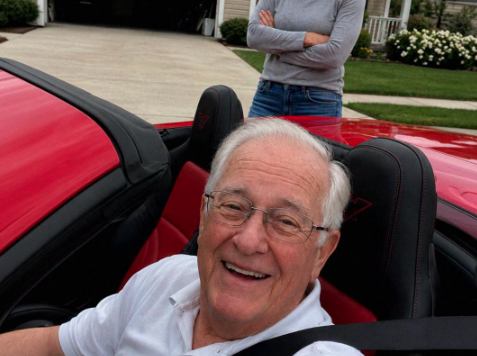
I had spent my entire life admiring beautiful luxury cars, but Margaret and I had never allowed ourselves to buy one.
I couldn’t make us young again.
But perhaps, just once, I could be reckless.
So I bought the most beautiful car I had ever seen.
It was far more expensive than anything I had ever owned.
I paid for it outright.
Then I added every feature I wanted.
And I used a large portion of the remaining money to book trips Margaret and I had spent decades postponing.
For the first time in my life, I spent a significant part of our savings on myself.
The news reached my children before the car had even been delivered.