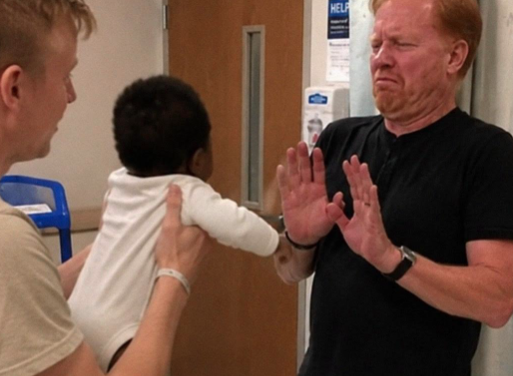
My father-in-law refused to hold my newborn daughter because she wasn’t the grandson he’d been waiting for.
He had spent months talking about the boy he was convinced would eventually carry on the family name. So when my daughter, Nora, was born, he looked into her bassinet, barely acknowledged her, and told us, “Maybe next time.”
I thought I understood what was wrong with him.
Then, five months later, he refused to hold her again at her baptism and made a comment about waiting for his “real” grandchild.
That was the moment something inside me changed.
But what happened afterward changed the way I understood George completely.
Because when I opened an old family album, I found something hidden among photographs from decades earlier. It revealed that the very family name George was so obsessed with preserving had once been given to him by a man who wasn’t his biological father.
And suddenly, his entire obsession with bloodlines, sons, and “carrying on the family name” looked very different.
It all started in the hospital.
“Well. Maybe next time.”
Those were the first words my father-in-law said after meeting my newborn daughter.
George had walked into my hospital room, glanced into Nora’s bassinet, and looked at her for perhaps two seconds before saying it.
My husband, Daniel, stared at him.
“Dad, do you want to hold her?”
George lowered himself into a chair in the corner of the room.
“I’ll do it later.”
A few minutes passed.
Daniel tried again.
“Come on. She’s your granddaughter.”
George barely glanced toward the bassinet.
“Later.”
Later never came.
He stayed in the hospital room for nearly an hour. He drank the coffee Daniel brought him, asked me how I was recovering, complained about the hospital parking, and talked about almost everything except the baby sleeping only six feet away.
When he finally stood to leave, he leaned over and kissed Daniel on the cheek.
He never went near Nora.
That was when I realized his “maybe next time” hadn’t been a badly timed joke.
He had meant it.
For most of my pregnancy, George had talked constantly about having a grandson.
He talked about taking him fishing.
Teaching him baseball.
Showing him how to work with tools.
But more than anything, he talked about one thing.
“Carrying on the family name.”
We had repeatedly told him that we weren’t going to find out the baby’s sex before the birth.
Apparently, George had interpreted that as permission to assume.
And when Nora arrived instead, he treated her as though she had somehow been the wrong answer.
Unfortunately, the hospital wasn’t the end of it.
Over the next five months, George continued keeping his distance from Nora.
At family gatherings, he would happily pick up my sister-in-law’s three-year-old son, Ethan. He’d bounce him on his knee, make him laugh, and tell anyone who would listen that Ethan was “carrying on the family name.”