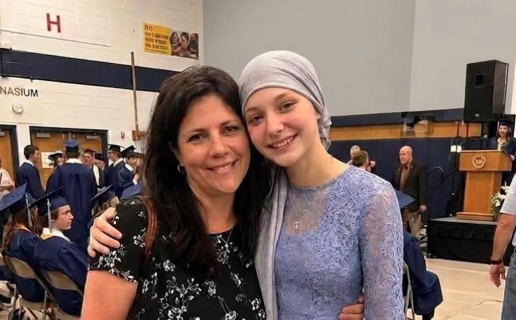
For fourteen months, my daughter Lily fought cancer.
She lost her hair.
She missed school dances, football games, and most of her senior year.
She learned how to smile while nurses searched for another vein.
She learned how to sit through scans without knowing what the results would show.
And she learned how to keep going on the days when simply getting out of bed felt like an achievement.
So when her doctor finally looked at her and said the words we had been waiting to hear—
“You’re in remission.”
—I thought the hardest part of our lives was finally behind us.
Lily’s first question wasn’t about going on vacation.
It wasn’t about getting her old life back.
It was about school.
“Can I still graduate with my class?”
Of course she could.
She had earned that moment in ways most people could never understand.
A few weeks later, Lily began preparing for graduation.
She bought a pale-blue dress.
Then she chose a silver headscarf.
When I asked her why she had picked silver, she smiled.
“It makes me look brave,” she whispered.
To Lily, the scarf wasn’t simply something to cover her head after losing her hair during chemotherapy.
It represented everything she had survived.
She called it the color of armor.
Every time she tied it around her head, she remembered the hospital rooms, the scans, the long treatments, and the mornings when she had been too exhausted to do anything except breathe.
The scarf represented survival.
Two days before graduation, Lily came home holding it in her hands.
Her eyes were swollen.
Tears were running down her cheeks.
I immediately knew something was wrong.
“What happened?”
She could barely get the words out.
“Mrs. Hargrove talked to me after rehearsal.”
Mrs. Hargrove was the school’s PTA president.
She had been responsible for organizing many of the graduation details, including seating arrangements and the professional photography package that cost each family $175.
According to Lily, Mrs. Hargrove had pulled her aside.
She had looked at Lily’s silver scarf and told her that the graduation ceremony was going to be photographed.
Then she said something I will never forget.
“She said I might make people uncomfortable,” Lily sobbed.
I sat down beside her.
“What else did she say?”
Lily wiped her face.
“She said the school wants happy, healthy-looking photographs.”
Then came the part that broke my heart.
“She said my scarf might ruin the pictures.”
For one terrible second, I couldn’t breathe.
This was my daughter.
The girl who had spent fourteen months fighting for her life.
The girl who had survived chemotherapy.
The girl who had missed most of her senior year but still wanted to stand beside her classmates when they received their diplomas.