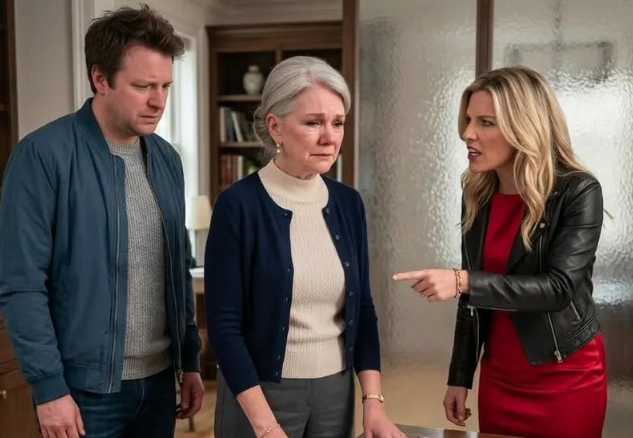
“My daughter-in-law demanded that I pay her $500,000 debt or lose my place in the family. I looked at my son standing beside her and said, ‘Then I’m not family.’ Three days later, my phone showed 98 missed calls. I sent one message that changed everything.”
“The $500,000 debt—you have to pay it,” my daughter-in-law said.
She stood across from me in my kitchen, arms crossed, her diamond bracelet catching the yellow light above the breakfast table.
“Or you’re no longer family.”
I looked at her.
Then I looked at my son.
Daniel stood beside his wife with both hands buried in his pockets, staring at the floor as though the kitchen tiles had suddenly become the most fascinating thing in the world.
I was sixty-four years old, widowed, and standing in the same kitchen where Daniel had taken his first steps.
The same kitchen where I had packed his school lunches.
The same kitchen where I had helped him with algebra.
The same kitchen where he and I had sat together after his father, Robert, died.
And now my son had come home to collect.
“Say something,” Marissa snapped.
I turned toward Daniel.
“Daniel?”
He swallowed.
“Mom, it’s complicated.”
“No,” I said quietly. “A half-million dollars isn’t complicated. It is specific.”
Marissa exhaled sharply.
“The investment failed. The bank is coming after us. If we don’t pay, we lose the house, the cars, everything.”
“The lake house?” I asked.
Daniel’s face tightened.
“The second SUV?” I continued. “The private preschool deposit? The country club membership?”
Marissa’s eyes flashed.
“This is not the time to judge our lifestyle.”
“I’m not judging,” I said.
“I’m counting.”
For a moment, nobody spoke.
Then Daniel finally looked at me.
“Dad left you money.”
The room went still.
My late husband had left me a retirement account, our house, and enough savings to live with dignity.
Not extravagance.
Dignity.
That money wasn’t a fortune waiting to be handed to the first family member who needed it.
It was what Robert had worked for so that I wouldn’t have to spend my final years worrying about whether I could afford my own life.
“That money is for me to survive on,” I said.
Marissa gave a short, cold laugh.
“You live alone. You barely spend anything.”
Something inside me settled.
It wasn’t anger.
It wasn’t sadness.
It was something harder.
I remembered Daniel at eight years old, crying because an older boy had taken his bicycle.
Robert had knelt beside him and said something Daniel had apparently forgotten.
“A man doesn’t become strong by taking from people who love him.”
I looked at my son.
“So,” Marissa said, leaning toward me, “are you going to help your family or not?”
I looked at both of them.
“Then I’m not.”
Daniel blinked.
“What?”
“If paying your debt is the price of being family, then I’m not family.”
Marissa’s mouth opened, but no words came out.
Daniel whispered:
“Mom, don’t do this.”
I held his gaze.
“I didn’t.”
“You did.”
They left angry.
Marissa slammed the door hard enough to rattle the windows.
I stood alone in my kitchen.
For the first time in years, I didn’t chase after them.
Three Days of Silence
Three days later, my phone showed 98 missed calls.
Most were from Daniel.
Several were from Marissa.
A few came from numbers I didn’t recognize.
I ignored almost all of them.
Eventually, I listened to one voicemail.
It was Daniel.
His voice was shaking.
“Mom, please. Marissa left. The bank froze the accounts. There’s something else you don’t know. Call me back.”
I stared at the screen for a long time.
Then I sent him one message.
I know everything. Bring the documents, not excuses.
He arrived at 7:12 that evening.
I know the exact time because I watched his headlights crawl across my living-room wall before disappearing behind the maple tree Robert had planted twenty-six years earlier.
Daniel didn’t knock right away.
Through the curtain, I watched him sitting in his car with both hands on the steering wheel.
His head was bent forward.
When he finally walked to the porch, he looked ten years older than he had three days earlier.
His coat was wrinkled.
His hair was uncombed.
He carried a folder beneath one arm and a cardboard box in both hands.
It was the kind of box people use when they leave an office unexpectedly.
I opened the door.
“Mom,” he said.
I stepped aside.
“Kitchen.”
He walked in without arguing.
That alone told me something had broken.
He placed the folder on the table.
Then he set down the box.
Inside were framed family photographs, a coffee mug from his company, a small bronze award with his name on it, and a plastic bag filled with papers.
I looked at him.
“You lost your job.”
His mouth trembled.
“Suspended. Pending investigation.”
I sat down.
“Then start there.”
Daniel remained standing for several seconds.
I could tell he expected me to offer coffee.
Comfort.
Something soft.
I didn’t.
Finally, he sat across from me like a man reporting to a judge.
“The debt isn’t just ours,” he said.
“It’s tied to Marissa’s brother.”
“Evan.”
I remembered Evan.
Slick hair.
Bright smile.
Always a little too comfortable around other people’s money.
Years earlier, he had tried to convince Robert to invest in a “guaranteed” real estate fund.
Robert had refused before Evan even finished his second sentence.
“Evan had a development deal in Arizona,” Daniel continued. “Short-term rental properties. He said investors were already lined up, but they needed bridge financing.”
He looked down.
“Marissa convinced me to sign.”
“You signed for half a million dollars?”
“It started at two hundred thousand,” he said quickly. “Then there were penalties. Extensions. Legal fees. I thought we could cover it when the deal closed.”
“But the deal didn’t exist.”
Daniel closed his eyes.
There it was.
The truth.
“Evan forged documents,” he said. “Fake permits. Fake investor letters. Fake escrow confirmations.”
I stared at him.
“Marissa knew?”
“Some of it.”
He swallowed.
“I didn’t know how much until yesterday.”
“And your company?”
Daniel pushed the folder toward me.
“I used my position to move client funds temporarily.”
The words sat between us.
I didn’t touch the folder.
“You stole money.”
“I was going to put it back.”
“That is what people say when they steal money.”
His eyes filled with tears.
“I panicked.”
“No,” I said. “You planned.”
He looked up.
“Panic is running a red light. This took passwords, signatures, transfers, and lies.”
He flinched.
But he didn’t deny it.
For the first time in years, I saw the little boy inside the grown man sitting across from me.
Not innocent.
Just terrified.
Why Marissa Really Left
I waited.
“Why did Marissa leave?”
Daniel gave a hollow laugh.
“Because when the bank froze the accounts, she said I was useless.”
He rubbed his face.
“She took the kids to her mother’s place in Connecticut.”
“And Evan?”
“Disappeared.”
“How convenient.”
Daniel nodded.
“She told me if I could get the money from you, she’d come back.”
I looked at my son for a long time.
There are pains that scream.
Then there are pains that become silent because they have gone too deep.
“Daniel,” I said, “you came here three days ago ready to throw me away for a woman who was already packing.”
He covered his face with both hands.
“I know.”
“No,” I said.
“You don’t know.”
He slowly lowered his hands.
“Not yet.”
The Brown Envelope
I stood and walked toward the hallway cabinet.
I pulled out a brown envelope.
Robert had taught me to keep copies of everything.
Bank letters.
Tax filings.
Insurance policies.
Property records.
And, during the previous six months, printouts of information I had quietly collected.
I placed the envelope on the table.
Daniel stared at it.
“What is that?”
“Evidence.”
His face drained.
“Your father distrusted Evan from the day he met him,” I said.
“After Robert died, Evan contacted me twice. He wanted me to invest in a property fund.”
“You refused.”
“Immediately.”
Daniel looked at the envelope.
“When I refused, he started asking strange questions about my accounts.”
I opened it.
“I hired a private investigator.”
Daniel’s expression changed.
I pulled out the first report.
“Evan has done this before.”
I placed another document beside it.
“Nevada.”
Another.
“Florida.”
Another.
“Colorado.”
“Different company names,” I said. “Different relatives. Same pattern.”
Daniel whispered:
“Oh my God.”
“There is more.”
I slid one printed email across the table.
The subject line read:
Daniel’s mother.
Daniel stared at it.
“Read it.”
He did.
The message was short.
She has enough. If Daniel pushes hard, she’ll pay. She’s lonely and afraid of losing him.
Daniel read it once.
Then again.
His tears stopped.
Something colder replaced them.
“She said that?”
“She wrote it.”
The kitchen became completely silent.
The only sound was the old refrigerator humming in the corner.
Daniel folded the paper slowly.
“What do I do?”
I looked at him.
“For once, you tell the truth.”
He stared at me.
“You’ll take those documents to an attorney tomorrow morning.”
He nodded.
“A criminal defense attorney. Not one of Evan’s friends.”
Another nod.
“You will cooperate.”
He swallowed.
“You will tell them what you did and what you know.”
His eyes dropped.
“You will not hide behind your wife.”
He remained silent.
“And you will not beg me to save you.”
Daniel finally looked up.
“What about the debt?”
“I will help you find a lawyer.”
He looked confused.
“But I will not pay the debt.”
His face crumpled with relief and shame at the same time.
“Thank you.”
I didn’t answer immediately.
Then I said:
“Don’t thank me yet.”
He looked at me.
“The worst part begins when people stop lying.”
The Consequences Came Quickly
Daniel followed my instructions.
He hired an attorney.
He cooperated with the investigation.
And for the first time, he stopped trying to protect himself with excuses.
The financial records painted a devastating picture.
Evan’s Arizona development scheme had been built on false promises and fabricated documents.
The supposed investors weren’t what they appeared to be.
The permits were fraudulent.
The escrow confirmations were fake.
And the money had been moving through a complicated network of accounts.
Marissa had known enough to understand that something was wrong.
She had simply decided that my money could make the problem disappear.
Daniel had gone even further.
In an attempt to keep everything from collapsing, he had made unauthorized financial decisions at work and moved client funds.
He had convinced himself he would replace the money.
He never did.
His comfortable career disappeared.
The company suspended him.
The investigation continued.
Marissa tried to distance herself from the entire situation.
But the emails told a different story.
So did the financial records.
So did the messages between her and Evan.
Eventually, the marriage ended.
Evan disappeared from the life he had been manipulating for years and faced serious legal consequences.
Marissa was forced to answer for her involvement.
And Daniel moved into a small apartment.
For the first time since he was a child, he had to live within his means.
There was no lake house.
No second SUV.
No country club membership.
No mother quietly covering the next crisis.
There was only the life he had created.
And the responsibility of fixing it.
A Year Later
A year passed.
Then one afternoon, I heard a car pull into my driveway.
I looked through the window.
Daniel stepped out.
His car was old.
Not impressive.
Not expensive.
But it was his.
In the back seat were my grandchildren, Lily and Mason.
Daniel knocked.
This time, he didn’t expect me to open the door simply because he was my son.
He waited.
I opened it.
“Hi, Mom.”
“Hi, Daniel.”
The children ran inside.
They hugged me.
For a moment, the house sounded like it used to.
Laughter.
Footsteps.
Voices.
Life.
Later that evening, after the children went to sleep, Daniel and I sat together in the kitchen.
The same kitchen.
The same table.
The same yellow light.
He looked at me.
“Do you forgive me?”
I thought about the question.
“I don’t know if forgiveness is something that happens all at once.”
He nodded.
“But I’m trying.”
He looked down.
“I’ve learned a lot.”
“I hope so.”
“I thought you would always save me.”
I looked at him.
“And now?”
“Now I know you love me enough not to.”
That sentence stayed with me.
Because that was what I had been trying to explain all along.
Helping someone doesn’t always mean removing the consequences of their choices.
Sometimes helping means refusing to let them destroy themselves.
Sometimes love means saying no.
Even when saying no hurts.
Even when the person you’re saying it to is your own child.
The Blueberry Pancakes
The next morning, Lily woke up early.
She wandered into the kitchen in her pajamas and climbed onto a chair.
“Grandma?”
“Yes?”
“Is it true you wouldn’t give Dad the money?”
I looked at Daniel.
He gave me a small nod.
So I answered honestly.
“I helped your dad.”
Lily looked confused.
“But you didn’t give him the money.”
“No.”
“Why?”
“Because sometimes helping someone means saying no.”
She thought about that.
Then she looked toward her father.
“Dad says that too.”
Daniel smiled.
“Dad’s finally learning.”
We made blueberry pancakes.
For the first time in a long time, the kitchen was filled with laughter instead of arguments about money.
There was no talk of debt.
No talk of banks.
No threats.
No demands.
Just pancakes, syrup, and two children arguing over who got the biggest one.
After breakfast, I returned to my room.
I opened the drawer where I had kept Daniel’s message.
The one I had sent after receiving those ninety-eight missed calls.
I read it again.
Bring the documents, not excuses.
At the time, I had believed refusing to give Daniel the money might cost me my family.
I thought saying no might mean losing my son.
Instead, it exposed the truth.
It protected my future.
It forced Daniel to confront what he had done.
And, perhaps most importantly, it gave him something money never could.
The chance to become responsible for his own life.
I still loved my son.
I still wanted him in my life.
But my love had changed.
It no longer meant unlimited access to my savings.
It no longer meant rescuing him from every mistake.
It no longer meant proving that I was family by paying the price for everyone else’s decisions.
I had finally learned that there is a difference between being a mother and being someone’s financial safety net.
And I learned something else, too.
Family isn’t the person who demands you sacrifice everything to prove you care.
Family is the person who can hear you say no and still choose to stand beside you.
Daniel had once stood in my kitchen while his wife demanded half a million dollars.
He had been too afraid to defend me.
A year later, he stood in that same kitchen and admitted something completely different.
He didn’t need my money.
He needed the chance to rebuild his own life.
And for the first time, I knew he understood the difference.
Because love had finally stopped being measured in dollars.
It was measured in something much harder.
Truth. Responsibility. And the courage to let someone face the consequences of their own choices.