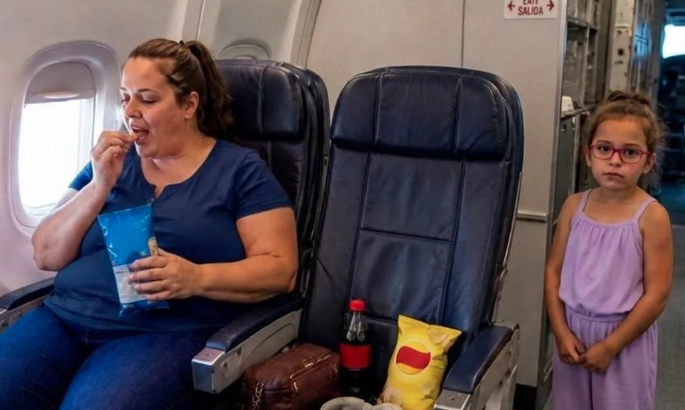
I knew the moment we reached row 7 that something was wrong.
My six-year-old daughter, Emma, was standing beside me, clutching her small backpack and looking eagerly toward the airplane window she had been talking about for weeks.
But someone else was already sitting in 7A.
A woman had settled into the seat as though it had always belonged to her. Her bag was tucked beneath the seat in front of her, her phone was already out, and she showed no sign of moving.
I checked my boarding passes again.
7A.
7B.
Exactly as I had booked them four months earlier.
“Excuse me, ma’am,” I said politely. “I think you’re sitting in my daughter’s seat.”
The woman looked at me with an irritated expression.
“I paid for a window seat,” she replied.
“So did I,” I said, holding up our boarding passes. “This one is reserved for my daughter.”
Emma was already looking toward the window.
The seat mattered to her for a reason most passengers would never know.
Emma has autism, and watching the sky, clouds, and sunlight through an airplane window helps calm her when she becomes overwhelmed. This was going to be her first flight, and I had spent months preparing her for it.
It was also our first real vacation since her father, Sean, died two years earlier.
I had finally decided that we needed to do something together—just Emma and me. A simple four-day beach trip had cost nearly $1,200, but to us, it represented something much bigger than a vacation.
It was supposed to be a new beginning.
The flight attendant, Lisa, arrived after noticing the disagreement.
She examined both boarding passes and then sighed.
“I’m so sorry,” she said. “The aircraft was changed this morning. Some passengers were automatically reassigned, and it appears this seat was assigned to two people.”
I explained Emma’s situation.
I told her that the window was not simply a preference for my daughter. It was something that helped her remain calm in unfamiliar situations.
Lisa nodded and turned toward the woman.
“Would you be willing to move to another available seat a few rows behind us? It would be an aisle seat.”
The woman immediately shook her head.
“No. I paid for a window seat, and I’m not moving.”
I tried again.
“Please. It’s really important for my daughter.”
The woman glanced at Emma and shrugged.
“Then let your daughter sit somewhere else.”
I lowered my voice.
“She has autism. She really needs the window seat.”
The woman’s response was blunt.
“That’s not my problem.”
I could feel people beginning to look in our direction.
Emma was watching all of us.
Her fingers had started trembling.
I recognized the signs immediately.
I could argue with a stranger in the middle of a crowded airplane, or I could focus on keeping my daughter calm.
I couldn’t do both.
So I swallowed my frustration and accepted two available seats in row 12.
Neither had a window.
As we walked away, I kept telling myself that everything would be okay.
I just hoped Emma would believe me.
Once the plane took off, the engines became louder, and Emma pressed her hands against her legs.
Twenty minutes into the flight, she began rocking gently.
“Mommy,” she whispered. “Sky. I want sky.”
My heart sank.
I tried to distract her with her tablet, snacks, and the small toys I had packed for the trip.
Nothing worked for long.
Then an older passenger noticed what was happening.
She leaned toward us and quietly offered to let Emma look through the window beside her once the seat-belt sign was turned off.
It wasn’t the seat I had paid for.
It wasn’t the experience I had imagined.
But it was kindness.
Emma looked through the window for a few moments, and her breathing slowly became steadier.
I thanked the woman, fighting back tears.
About ninety minutes into the flight, the captain’s voice came over the intercom.
“Ladies and gentlemen, we’d like to take a moment to recognize something that happened on this flight.”
The cabin became noticeably quieter.
Then Captain Brown continued.
“We often talk about safety, comfort, and service. But there is another thing that matters when we travel together: how we treat the people sitting beside us.”
Several passengers turned toward row 7.
Lisa approached the woman in 7A carrying a small package.
For a moment, the woman appeared pleased.
She smiled as though she believed she was about to receive some kind of special recognition.
Then she opened the box.
Her expression changed.
Inside was a handwritten note from the crew explaining that they had witnessed the disagreement over the window seat involving a young child with autism.
The message was polite, but unmistakably clear.
The crew had noticed that an opportunity to show kindness had been refused.
The woman stared at the note.
The cabin fell silent.
Captain Brown then continued speaking over the intercom.
“We also want to recognize another kind of passenger today—people who help without being asked.”
He thanked a couple sitting in row 19.
They had quietly volunteered their window seat for Emma once the seat-belt sign was turned off.
The cabin erupted into applause.
Lisa returned to our row and asked whether Emma would like to move.
I looked at my daughter.
Her eyes immediately lit up.
We moved to the window.
The moment Emma pressed her face against the glass, I watched her entire body relax.
She stared at the clouds beneath us.
“Mommy,” she whispered, smiling for the first time in nearly an hour. “They look like pillows.”
I laughed through my tears.
The couple who had given up their seats simply smiled.
“You’re welcome,” they said. “We’re happy she gets to see them.”
That simple gesture meant more to me than they could have known.
No legal document, financial agreement, reservation policy, or official rule could have forced someone to give up a seat for my daughter.
They chose to do it.
And that was what made the difference.
After we landed, Captain Brown met Emma near the cockpit.
He crouched down to her level and handed her a pair of small souvenir wings.
“You did a wonderful job,” he told her.
Then he looked at me.
“And so did you.”
I thanked him.
As we walked away from the airplane, I realized I wasn’t thinking about the woman in 7A anymore.
I wasn’t thinking about the argument.
I wasn’t thinking about who had been right or wrong.
What stayed with me was something much simpler.
One person had refused to make a small sacrifice for a frightened child.
But several strangers had stepped forward without being asked twice.
An older passenger offered a window.
A couple gave up their seats.
A flight attendant listened.
And a captain made sure the lesson was about compassion rather than humiliation.
Emma’s first flight had not gone exactly as I planned.
But years from now, I doubt she will remember the woman who refused to move.
I hope she remembers the clouds.
The people who helped her see them.
And the moment she looked out of that window, smiled, and whispered that the sky looked like pillows.