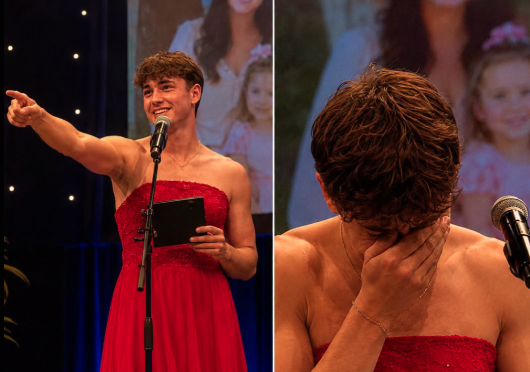
My Son Walked Across Graduation in His Sister’s Red Dress – Then Everyone Learned Why
The laughter began before my son even reached the principal.
At first, it was only whispering.
Then came the giggles.
Someone sitting toward the back of the auditorium didn’t even bother lowering his voice.
“What is wrong with that guy?”
I heard it clearly.
So did everyone around me.
But Aaron kept walking.
He didn’t look toward the students pointing their phones at him. He didn’t glance at the parents whispering behind their programs. He didn’t hesitate when he reached the stage.
He simply walked toward the principal, shook his hand, accepted his diploma and turned to face the audience.
Six hundred people were watching him.
And many of them were laughing.
I was sitting in the third row.
I was also the only person in that auditorium who knew why my eighteen-year-old son was wearing a bright red dress.
Two weeks earlier, he had told me his plan.
It was almost two in the morning.
Neither of us had been sleeping much.
Our kitchen was dark except for the light above the stove, and Aaron was sitting at the table with his hands wrapped around a mug he wasn’t drinking from.
Then he finally told me.
“Mom, I’m going to wear Mary’s dress to graduation.”
I stared at him.
For a moment, I didn’t know what to say.
Then I begged him not to.
“They’ll eat you alive,” I told him.
“I know.”
“Aaron, people are going to laugh.”
“I know, Mom.”
“They’ll take pictures.”
“I know.”
“You don’t have to prove anything.”
He looked at me for a long time.
“I know,” he said again. “But it doesn’t matter.”
To Aaron, it wasn’t about proving anything.
It was about keeping a promise.
The dress belonged to his twin sister, Mary.
She had died only months earlier after a serious illness.
She never got to see graduation.
She never got to walk across that stage.
She never got to receive the diploma she had spent years working toward.
But before she died, Mary had made a decision.
And Aaron had promised to honor it.
I just didn’t understand how much that promise meant until I saw him standing on that stage.
Mary had always been the brighter one.
The louder one.
The twin who could make Aaron laugh when he was determined not to.
They had been inseparable as children.
They argued over clothes, music, television and who got the last piece of cake.
Then Mary got sick.
Our family changed.
Hospital rooms replaced school hallways.
Medical appointments replaced weekend plans.
Our conversations became quieter.
And every ordinary moment became precious.
A few weeks before Mary died, she and I went shopping together.
She found the red dress.
It cost $89.
She loved it immediately.
I remember telling her she didn’t need another dress.
She laughed and said I was officially becoming the kind of mother who could be arrested for ruining someone’s fashion choices.
That afternoon, she picked a yellow daisy outside the hospital.
One of the petals was missing.
She held it up like it was some priceless treasure.
I had no idea then that she had kept it.
Or that she had written something for Aaron.
Three days before she died, she gave him both.
She made him promise not to tell me.
The school found out about Aaron’s plan shortly before graduation.
They called me that morning.
They said they wanted to help.
They offered him a different outfit.
Something they described as a “more appropriate option.”
Aaron politely declined.
His father, Dean, was even more direct.
He refused to attend.
He told Aaron not to turn graduation into a spectacle.
Then Aaron’s closest friend, Ben, stopped responding to his messages.
By graduation morning, my son knew exactly what was waiting for him.
He knew people would stare.
He knew some would laugh.
He knew there would be photographs.
And he wore the dress anyway.
Now, standing in the third row, I watched him accept his diploma.
He looked toward the audience.
For half a second, our eyes met.
Then he walked down the stage steps.
I expected him to go toward the photographers.
Instead, he turned.
He walked directly toward me.
The auditorium was still buzzing.
People were whispering.
Phones were raised.
Aaron stopped in front of my seat.
His eyes were wet.
“This is for you,” he whispered.
Then he added:
“Both of them.”
He reached into the pocket of the red dress.
He pulled out a small object wrapped carefully in tissue paper.
My hands began to shake before I even knew what I was looking at.
He placed it in my hand.
I opened it.
Inside was a dried yellow daisy.
One petal was missing.
I recognized it immediately.
My breath caught.
Then I saw the folded piece of paper beneath it.
Mary’s handwriting.
The same handwriting I had seen on school assignments, birthday cards and notes left on the kitchen counter.
I began reading.
Mary had known she might never make it to graduation.
She had known there was a possibility she would never stand beside her brother on that stage.
But she didn’t want the red dress to become another object hidden away in a closet, something we could only look at while remembering what we’d lost.
She wanted Aaron to wear it.
She wanted me to see both of my children graduate together.
I couldn’t stop crying.
And then something happened that I will never forget.
The auditorium became quiet.
The laughter disappeared.
One phone lowered.
Then another.
The mothers sitting beside me, some of whom had been giggling only minutes earlier, stopped talking completely.
Even the students who had been pointing at Aaron were silent.
The principal walked toward us.
He had clearly realized that there was a story behind what he had just witnessed.
He apologized.
Then he invited Aaron back onto the stage.
Aaron stood beneath the graduation lights and told everyone about Mary.
He explained that the dress wasn’t a joke.
It wasn’t a stunt.
It wasn’t meant to embarrass anyone.
It was a promise between a brother and a sister.
He held up the daisy.
He told them about the hospital.
He told them that Mary had wanted to be remembered not for the illness that took her, but for the life she had lived.
And then her graduation photograph appeared on the large screen behind him.
For a few seconds, nobody moved.
Then someone stood.
Another person followed.
Then another.
Within moments, the entire auditorium was standing.
The applause was overwhelming.
Aaron stood there holding his sister’s dress and the tiny yellow flower.
And I realized that the same room that had laughed at him minutes earlier was now applauding him.
After the ceremony, people approached us quietly.
Some apologized.
One parent admitted that she had judged Aaron before knowing anything about the situation.
A student who had laughed earlier came over and said he was sorry.
Then Ben appeared.
Aaron’s best friend had spent weeks avoiding him because he thought Aaron was trying to make a statement that would embarrass everyone.
“I should have asked,” Ben said.
Aaron nodded.
“I was making a statement,” he told him.
Ben looked confused.
“Just not the one you thought.”
Then my phone buzzed.
It was a message from Dean.
He had received a video from the ceremony.
His message contained only five words:
I should have been there.
I read it twice.
I didn’t respond.
Aaron didn’t ask me to.
That evening, we went home.
The house felt different.
Not happier exactly.
Mary was still gone.
Nothing could change that.
But for the first time in months, one of her memories didn’t feel like a wound.
We took the yellow daisy and placed it inside a small frame.
Then we hung it beside an old photograph of the twins when they were eight years old.
They were standing shoulder to shoulder, both missing their front teeth, both smiling so hard their eyes had nearly disappeared.
I looked at the photograph for a long time.
For months, every picture of Mary had reminded me of what we had lost.
That night, I saw something else.
I saw a girl who had loved her brother enough to plan one final gift.
I saw a brother who was willing to walk through six hundred people laughing because keeping his promise mattered more than protecting himself from embarrassment.
And I saw the two of them together again.
Not physically.
Not in the way I wanted.
But in the only way that was still possible.
Aaron had walked across that stage wearing Mary’s red dress.
He had carried her flower.
He had carried her words.